
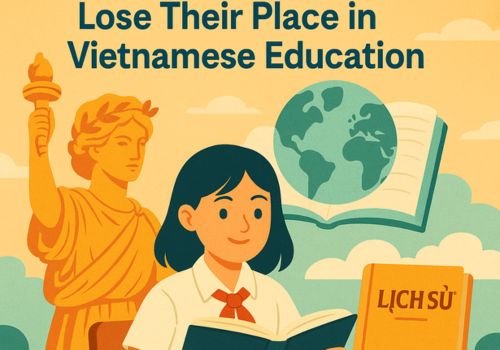
(A cultural guide for Vietnamese learners around the world)
When foreigners begin learning Vietnamese, they often start with vocabulary, tones, or daily conversations. Yet to truly understand Vietnam — its people, values, and identity — language alone is not enough.
You must also step into the world of Văn – Sử – Địa, the traditional trio of subjects taught to every Vietnamese student:
Literature (Văn), History (Sử), and Geography (Địa).
In recent years, many universities in Vietnam have reduced or removed this subject combination in their entrance exams. At first glance, it seems like a technical change. But behind it lies a deeper question:
What do we want future generations to understand about their country?
Văn – Sử – Địa: The cultural compass of Vietnam
Each subject opens a different door into Vietnamese civilization.
📘 Literature (Văn)
Vietnamese literature is more than poetry or novels. It is the voice of the Vietnamese soul — emotional, resilient, delicate, and philosophical. Through literature, you see how Vietnamese people express love, suffering, gratitude, hope, and identity.
For anyone learning Vietnamese, literature reveals the heart behind the words.
📜 History (Sử)
Vietnam has over 4,000 years of recorded history, marked by invasions, resistance, and cultural continuity.
History teaches you why Vietnamese people value independence, why community is important, and why traditions survive even after centuries of conflict.
You understand that every street name, every festival, and every family story carries layers of meaning.
🌏 Geography (Địa)
Vietnamese culture is deeply shaped by its land.
From the rice fields of the Bắc Bộ Delta to the Mekong River’s floating markets and the mountainous ethnic regions — geography explains why lifestyles differ, how cuisine varies, and why regional accents developed the way they did.
Together, these three subjects build a complete picture of Vietnam as a living organism — its people, its past, and its place in the world.
Why removing this trio is risky
Some universities argue that removing Văn – Sử – Địa makes exam scoring easier and aligns with technical fields.
But the consequence is that students may grow up with less understanding of:
- how Vietnamese culture formed,
- how history influences modern life,
- how geography shaped food, trade, and daily habits.
A society can produce excellent engineers and programmers —
but without the humanities, it risks losing its cultural memory.
Even leaders in Silicon Valley admit that in the age of Artificial Intelligence, technical skill alone is not enough. Engineers must understand human needs, ethics, fairness, and cultural context — things no machine can interpret on its own.
Understanding Vietnam requires both language and culture
Harvard and Stanford require all students to study literature, history, and philosophy regardless of major.
Vietnamese education used to share this spirit — and Văn – Sử – Địa was its foundation.
For learners of Vietnamese:
- Literature helps you appreciate beauty in everyday expressions.
- History gives depth to the stories you hear.
- Geography helps you understand regional identities, accents, and customs.
When you learn all three, Vietnam becomes not just a place —
but a living, breathing narrative you can truly enter.
A message to learners of Vietnamese around the world
If you want to understand Vietnam beyond grammar and pronunciation, let Văn – Sử – Địa guide you.
- Read Vietnamese poems and short stories.
- Visit historical sites and museums.
- Travel across regions to hear different dialects.
Vietnam is a country of emotional depth, historical resilience, and geographical diversity — and this trio of subjects is the map that shows you the way.
Conclusion
Văn – Sử – Địa is not simply an old-school combination of subjects.
It is the cultural DNA of Vietnam.
To truly learn Vietnamese is to learn the people who speak it —
their stories, their landscapes, their memories.
We invite you to follow Vietnamese Language Journey to explore more articles, cultural insights, and learning materials that bring you closer to the heart of Vietnam.
🎯 Please check out the information about our Vietnamese language courses!
✨ For more in-depth insights into Vietnam’s culture, history, and modern society, you are warmly invited to explore the articles on the Nguyễn Công Khanhwebsite.

This is a very interesting article, thank you to the author!
You’re always welcome. See you soon!
Admin