
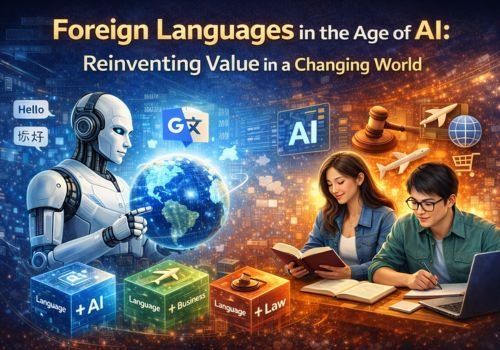
In recent years, the rapid rise of artificial intelligence has sparked a global debate: Are foreign languages becoming obsolete? With tools like ChatGPT and Google Translate now capable of translating text, speech, and even video in seconds, many people are beginning to question the future of language learning.
But is this truly the end of foreign languages—or the beginning of a new era?
The Shift: From Essential Skill to Common Tool
Not long ago, mastering a foreign language was considered a powerful competitive advantage. It opened doors to international careers, cross-border communication, and cultural exchange.
Today, AI has dramatically lowered that barrier.
Instant translation apps can help travelers navigate foreign countries, businesses communicate globally, and students access knowledge in multiple languages. As a result, language proficiency is no longer a rare asset—it is becoming a baseline expectation.
This shift is already visible in education systems. Some universities have begun reducing or restructuring language programs, reflecting changing market demands and student interests.
The Reality: AI Can Translate Words, Not Meaning
Despite impressive technological advances, AI still falls short in one critical area: human understanding.
Language is more than vocabulary and grammar. It carries:
- Cultural nuance
- Emotional tone
- Contextual meaning
- Social sensitivity
AI can process patterns, but it cannot fully grasp intention, irony, humor, or deep cultural references.
For example, a perfectly translated sentence may still feel unnatural—or even inappropriate—if it lacks cultural awareness. This is where human language skills remain indispensable.
The Job Market: A Wake-Up Call
The decline in traditional language-related jobs—such as translation, teaching, and basic international communication—has created concern among students and educators alike.
However, the real issue is not the disappearance of opportunities, but the transformation of them.
Today’s employers are no longer looking for “language-only” candidates. Instead, they seek professionals who combine language skills with domain expertise.
In other words, the market is shifting from:
“I speak a foreign language”
to
“I use a foreign language to solve real-world problems.”
The Future: “Language + X” as a Winning Strategy
To stay relevant in the AI era, learners must adopt a new mindset: integrate language skills with other disciplines.
Promising combinations include:
- Language + Artificial Intelligence
- Language + International Business
- Language + Law or Diplomacy
- Language + Digital Marketing
This “Language + X” model transforms language from a standalone skill into a powerful multiplier of professional value.
Education Must Evolve
The current disruption also highlights a deeper issue: outdated education models.
Traditional language programs often focus heavily on grammar and theory, while neglecting real-world application and interdisciplinary learning.
To remain relevant, institutions must:
- Integrate technology into language training
- Emphasize critical thinking and communication
- Encourage cross-disciplinary programs
- Prepare students for global, digital environments
AI should not replace education—it should enhance it.
A New Perspective: Opportunity, Not Threat
Rather than fearing AI, language learners should embrace it as a tool.
AI can:
- Accelerate learning
- Provide instant feedback
- Expand access to global content
- Support real-time communication
Those who know how to combine human insight with AI efficiency will gain a significant advantage.
Conclusion: Languages Are Evolving, Not Disappearing
Foreign languages are not dying—they are transforming.
In the age of AI, the value of language lies not in simple translation, but in deep understanding, cultural intelligence, and meaningful communication.
For learners, educators, and professionals alike, the message is clear:
👉 Adapt, integrate, and evolve.
Because in a world powered by AI, the true advantage does not belong to those who speak more languages—but to those who know how to use them wisely.
👉 We invite you to explore more insightful articles and practical guidance on our “Vietnamese Language Journey” website to deepen your understanding of language learning in the AI era.
👉 Don’t forget to visit the “Nguyen Cong Khanh” website to discover a diverse ecosystem of business, education, real estate, and digital opportunities waiting for you!
